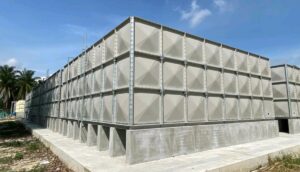
Choosing the right water tank for a commercial building is not only about storage capacity. For hotels, schools, hospitals, office buildings, shopping malls and mixed-use developments, the water tank must support daily water demand, emergency backup, safe storage, easy maintenance and long-term project operation.
A good commercial building water tank should match the building type, installation space, water usage, local climate, water quality requirements and project budget. For many modern construction projects, modular water tanks, GRP water tanks and SMC water tanks are commonly selected because they are easier to transport, assemble and customize compared with many traditional welded tanks.
If you are planning a hotel, school, hospital or commercial building project, this guide will help you understand how to choose the right water tank solution.
CTA: solution for your commercial building? Send us your building type, required capacity and installation location to get a suitable tank recommendation.
Why Commercial Buildings Need a Proper Water Tank System
Commercial buildings usually have higher and more complex water demand than residential buildings. A hotel may need water for guest rooms, kitchens, laundry areas and HVAC systems. A school may require stable water supply for classrooms, dormitories, canteens and toilets. A hospital needs reliable water storage for hygiene areas, patient rooms, cleaning systems and emergency backup.
For these projects, the water tank is not just a storage container. It is part of the building’s water supply system. If the tank is poorly selected, the project may face problems such as insufficient water supply, difficult installation, poor maintenance access, contamination risk or higher long-term operating cost.
Building water systems also need proper management. CDC guidance on building water management programs focuses on reducing the growth and spread of Legionella in building water systems, especially in facilities where water systems may create health risks. This is particularly important for large commercial buildings, hotels, hospitals and other public-use buildings.
Common Water Storage Applications in Commercial Buildings
Different buildings use water in different ways. Before choosing a tank, you should first understand the main water storage purpose.
| Building Type | Common Water Use | Key Selection Focus |
|---|---|---|
| Hotel | Guest rooms, laundry, kitchen, cleaning, backup water | Stable supply, peak demand, corrosion resistance, easy maintenance |
| School | Toilets, canteen, dormitory, cleaning, emergency reserve | Large user volume, safety, simple maintenance |
| Hospital | Patient areas, hygiene rooms, cleaning, backup supply | Water safety, reliability, easy inspection |
| Office Building | Domestic water, cleaning, facility operation | Space efficiency, flexible capacity |
| Shopping Mall | Toilets, restaurants, cleaning, fire reserve | Large capacity, separate water functions, durable structure |
| Commercial Complex | Domestic water, HVAC, facility service, fire reserve | Custom design, modular installation, long-term operation |
For most commercial projects, the best water tank is not a “standard product” but a project-based solution.
Step 1: Define Your Building Type and Water Demand
The first step is to clarify how the building will use water. This helps determine the tank size, material, structure and installation method.
Water Tank for Hotels
Hotels usually have continuous and peak-hour water demand. Guest rooms, kitchens, laundry rooms, restaurants, swimming pools and cleaning areas may all increase total consumption. For hotel projects, water tanks should be selected based on:
- Number of rooms
- Expected occupancy rate
- Laundry and kitchen demand
- Rooftop or basement installation space
- Backup water requirement
- Maintenance access
For hotels, a Modular Water Tank or GRP Water Tank is often suitable because both can support flexible capacity and project-based installation.
Planning a hotel water storage project? Send us the number of rooms and installation location to get a recommended tank capacity.
Water Tank for Schools
Schools usually need stable water supply during concentrated usage periods, such as breaks, lunch time and dormitory peak hours. The water tank should be easy to maintain, safe for long-term use and suitable for large groups of users.
For school projects, selection should consider:
- Number of students and staff
- Dormitory or non-dormitory use
- Canteen water demand
- Toilet and cleaning demand
- Emergency water storage
- Maintenance frequency
An SMC Water Tank or modular sectional tank can be a practical option for school buildings because the tank can be customized based on space and capacity needs.
Water Tank for Hospitals
Hospitals have stricter requirements for water stability, hygiene and emergency backup. The water tank should support reliable daily use and allow regular inspection and cleaning.
Hospital projects should focus on:
- Number of beds
- Hygiene and cleaning demand
- Backup water supply
- Easy internal inspection
- Sealed structure
- Safe material selection
- Separate water storage requirements
WHO guidance recommends water safety plans as a key risk-management method for consistently ensuring the safety and acceptability of drinking-water supply. This makes project planning, inspection access and safe storage design especially important for hospitals and healthcare-related facilities.
For hospitals, SMC water tanks and GRP water tanks are commonly considered depending on the project requirement, material specification and local standards.
Water Tank for Office Buildings and Commercial Complexes
Office buildings, shopping malls and commercial complexes usually need water tanks for domestic water, cleaning, facility operation and sometimes fire reserve. These buildings often have limited installation space, so a modular design is helpful.
A modular water tank is suitable for many commercial buildings because panels can be transported separately and assembled on site. This makes it easier to install the tank in basements, rooftops, equipment rooms or limited-access spaces.
Step 2: Calculate the Required Water Tank Capacity
Water tank capacity should not be guessed. It should be calculated according to building function, user number, water demand and local project regulations.
For commercial buildings, tank capacity usually depends on:
- Building type
- Number of users, rooms, beds or tenants
- Daily water consumption
- Peak water demand
- Backup water duration
- Firefighting reserve
- Available installation space
- Local building code
- Local water supply stability
For example, a hotel tank capacity may be calculated based on the number of guest rooms, expected occupancy, kitchen use and laundry demand. A school may calculate capacity based on student number, dormitory use and canteen demand. A hospital may need to consider bed number, hygiene areas and emergency backup.
| Project Type | Capacity Calculation Focus |
|---|---|
| Hotel | Number of rooms, occupancy rate, kitchen, laundry, backup water |
| School | Student number, staff number, dormitory, canteen, toilets |
| Hospital | Bed number, hygiene demand, patient areas, emergency reserve |
| Office Building | Floor area, staff number, toilets, cleaning demand |
| Shopping Mall | Visitor traffic, restaurants, toilets, cleaning, fire reserve |
If the water tank is also related to fire protection, the design should follow local fire codes and project-specific requirements. NFPA 22 provides requirements for the design, construction, installation and maintenance of water tanks and accessory equipment used to supply water for private fire protection.
Not sure what capacity your project needs? Send us your building type, user number and tank location. TIY can help recommend a suitable water tank capacity.
Step 3: Choose the Right Water Tank Material
The tank material affects service life, water safety, corrosion resistance, installation method and maintenance cost. For commercial building projects, the most common options include modular water tanks, GRP water tanks and SMC water tanks.
Modular Water Tank for Commercial Buildings
A Modular Water Tank is a sectional water storage system assembled from panels on site. It is especially suitable for commercial buildings where transportation, installation access and capacity flexibility are important.
Why Choose a Modular Water Tank?
A modular water tank is suitable when the project requires:
- Flexible tank size
- Easy transportation
- On-site assembly
- Basement or rooftop installation
- Large capacity customization
- Future maintenance access
- Export project convenience
Because the tank is delivered in panels, it can be easier to move into restricted spaces compared with one-piece tanks. This is useful for hotels, schools, hospitals and commercial buildings where installation space may be limited.
Best Applications
| Application | Why Modular Tank Works |
|---|---|
| Hotel | Flexible capacity for guest rooms, kitchen and laundry |
| School | Suitable for large daily water demand |
| Hospital | Can be designed for backup water storage |
| Office Building | Easy to install in basement or rooftop areas |
| Shopping Mall | Suitable for large-capacity commercial projects |
View TIY Modular Water Tank solutions for commercial buildings, hotels, schools and hospitals.
GRP Water Tank for Commercial and Hot-Climate Projects
A GRP Water Tank is widely used in building water storage projects because it is lightweight, corrosion-resistant and suitable for modular panel assembly.
GRP stands for glass reinforced plastic. It is often selected for projects where corrosion resistance and long-term stability are important. For hot-climate countries, coastal areas or humid environments, GRP water tanks can be a practical option.
Why Choose a GRP Water Tank?
A GRP water tank is suitable for:
- Potable water storage
- Hot-climate projects
- Coastal or humid environments
- Commercial buildings
- Hotels and schools
- Overseas construction projects
- Rooftop or ground installation
For drinking water projects, material safety should always be checked according to local standards. NSF/ANSI/CAN 61 is a standard used to evaluate health effects related to products, components and materials that may contact drinking water.
Best Applications
| Application | Why GRP Tank Works |
|---|---|
| Hotel | Suitable for domestic water and rooftop installation |
| School | Corrosion-resistant and suitable for long-term use |
| Commercial Building | Lightweight and easy to assemble |
| Hot-Climate Country | Better corrosion resistance than many metal options |
| Coastal Project | Suitable for humid or corrosive environments |
Compare TIY GRP Water Tank options for your commercial water storage project.
SMC Water Tank for Building, Firefighting and Industrial Projects
A SMC Water Tank is made from molded SMC panels and assembled into a sectional water storage system. It is often used in buildings, schools, hospitals, commercial complexes and firefighting water storage projects.
SMC water tanks are suitable for projects that need a standardized panel structure, stable performance and flexible installation.
Why Choose an SMC Water Tank?
An SMC water tank is suitable when the project requires:
- Molded panel structure
- Modular installation
- Stable tank body
- Building water storage
- Fire reserve water storage
- Flexible capacity design
- Easy transportation and assembly
Best Applications
| Application | Why SMC Tank Works |
|---|---|
| School | Stable structure for daily water storage |
| Hospital | Suitable for building water and backup supply |
| Commercial Complex | Can support large-capacity sectional design |
| Firefighting Water | Can be designed according to project requirements |
| Industrial Building | Suitable for utility water storage |
Request an SMC Water Tank design based on your building drawings and project requirements.
Step 4: Compare Modular, GRP and SMC Water Tanks
The best water tank depends on your building type, location, water usage and installation conditions.
| Tank Type | Best For | Main Advantages | Recommended Projects |
|---|---|---|---|
| Modular Water Tank | Flexible building projects | Easy transport, flexible capacity, on-site assembly | Hotels, schools, hospitals, commercial buildings |
| GRP Water Tank | Potable water and hot-climate projects | Corrosion resistance, lightweight panels, long-term stability | Hotels, schools, commercial buildings, coastal projects |
| SMC Water Tank | Building and firefighting water storage | Molded panel structure, modular installation, stable performance | Hospitals, schools, commercial complexes, fire reserve projects |
Simple Selection Logic
Choose a Modular Water Tank if your project needs flexible capacity, easy transportation and on-site assembly.
Choose a GRP Water Tank if your project requires corrosion resistance, lightweight structure or hot-climate adaptability.
Choose an SMC Water Tank if your project needs molded panel structure, building water storage or firefighting water storage support.
Recommended Water Tank Solutions by Building Type
Different buildings should use different water tank solutions. The following table can be used as a simple selection guide.
| Building Type | Recommended Tank Solution | Why |
|---|---|---|
| Hotel | Modular Water Tank / GRP Water Tank | Flexible capacity, corrosion resistance, suitable for rooftop or basement installation |
| School | SMC Water Tank / Modular Water Tank | Stable structure, easy maintenance, suitable for large daily water demand |
| Hospital | SMC Water Tank / GRP Water Tank | Suitable for reliable backup supply and safe water storage design |
| Shopping Mall | Modular Water Tank / SMC Water Tank | Large capacity, fire reserve and commercial building water use |
| Office Building | Modular Water Tank | Flexible design for basement, rooftop or equipment room installation |
| Mixed-Use Building | Modular Water Tank / GRP Water Tank | Suitable for complex water demand and project-based customization |
Tell us your building type and required capacity. TIY will recommend a suitable modular, GRP or SMC water tank solution for your project.
How to Request a Water Tank Quotation for a Commercial Building
To get an accurate quotation, you should provide as much project information as possible.
Recommended information includes:
- Building type
- Project location
- Required tank capacity
- Installation location
- Tank dimensions if available
- Water usage type
- Domestic water or firefighting water
- Drawing or layout plan
- Inlet and outlet requirements
- Material preference
- Delivery destination
The more complete the information, the more accurate the tank design and quotation will be.
Send your tank capacity, project location and building drawings to TIY. Our team will help you choose the right water tank and provide a project-based quotation.
FAQ
What is the best water tank for commercial buildings?
The best water tank depends on the building type, capacity, installation space and water usage. For many commercial buildings, modular water tanks, GRP water tanks and SMC water tanks are practical options because they support flexible design and on-site assembly.
How do I calculate water tank capacity for a hotel?
Hotel water tank capacity should be calculated based on the number of rooms, occupancy rate, kitchen demand, laundry demand, cleaning demand and backup water requirement. If the tank is related to fire protection, local fire code requirements should also be considered.
Is a GRP water tank suitable for drinking water?
A GRP water tank can be used for potable water projects when the material and accessories meet the required drinking water standards for the project location. Buyers should confirm material specifications and local compliance requirements before ordering.
What is the difference between GRP and SMC water tanks?
GRP water tanks are commonly selected for corrosion resistance, lightweight structure and hot-climate projects. SMC water tanks use molded panels and are often selected for building water storage, firefighting water storage and sectional installation projects.
Can a modular water tank be installed in a basement?
Yes. Modular water tanks are suitable for basement installation because the panels can be transported separately and assembled on site. Before installation, the project should confirm door access, ceiling height, drainage, foundation and maintenance clearance.
Conclusion: Choose a Water Tank Based on the Project, Not Only the Price
A commercial building water tank should be selected according to real project conditions. Hotels, schools, hospitals and commercial buildings all have different water demand, safety requirements and installation challenges.
For flexible installation and project customization, a Modular Water Tank is often a strong option. For corrosion resistance and hot-climate projects, a GRP Water Tank can be a practical solution. For building water storage, firefighting water and stable panel structure, an SMC Water Tank may be suitable.
TIY provides modular water tank, GRP water tank and SMC water tank solutions for commercial buildings, hotels, schools, hospitals and overseas construction projects.
Need help choosing the right water tank for your commercial building?
Send us your building type, required capacity, installation location or project drawing. TIY will recommend a suitable water tank solution based on your project requirements.