A Practical Buyer’s Guide for Contractors, Distributors & Project Owners
When planning water storage for international projects, choosing the right tank type is not just about price — it directly affects shipping cost, installation efficiency, project timeline, and long-term durability.
Two of the most common options are:
Modular (Panel) Water Tanks
Welded (Steel) Water Tanks
So, which one is better for export projects?
Let’s break it down from a real procurement perspective.
Looking for a reliable modular water tank supplier for your export project?
Why Export Projects Have Different Requirements
Export projects present a unique set of challenges that domestic projects don’t face. Logistics become far more complex, with international shipping costs, customs, and transportation to remote sites adding significant expenses. You need a solution that is easy and cost-effective to ship, simple to assemble with potentially limited local skilled labor, and built for long-term durability to avoid costly international repairs.
This is where the choice of a water tank becomes critical. A tank that is difficult to transport can inflate your budget before construction even begins. Similarly, a lengthy and complex installation time can lead to project delays and increased labor costs. For applications like potable water systems or wastewater storage tanks in another country, you need a reliable solution that minimizes logistical headaches. This is why modular tanks are increasingly favored for export projects.
Modular vs Welded Water Tanks — Quick Comparison
Choosing between modular and welded water tanks depends heavily on your project’s specific needs, especially when it involves exporting. Welded tanks are built on-site by welding large steel plates together, forming a permanent structure. In contrast, modular tanks are made from pre-fabricated panels that are bolted together at the destination. This fundamental difference impacts everything from shipping and labor costs to longevity and flexibility.
The main distinctions come down to installation, cost, and adaptability. While welded tanks are known for their structural integrity, modular tanks offer superior corrosion resistance and are much easier to transport. Here is a quick comparison:
Feature | Modular Water Tanks (GRP / FRP / SMC) | Welded Water Tanks (Steel) |
|---|---|---|
Shipping | ⭐⭐⭐⭐ Flat-packed (low cost) | ⭐ Bulky, high freight |
Installation | ⭐⭐⭐⭐ Bolt assembly | ⭐ Requires welding |
Labor Requirement | Low | High (skilled welders) |
Corrosion Resistance | ⭐⭐⭐⭐ Excellent | ⭐⭐ Depends on coating |
Maintenance | Low | Medium–High |
Lifespan | 15–30 years | 10–20 years |
Project Flexibility | ⭐⭐⭐⭐ Expandable | ⭐ Limited |
Installation Time | Fast | Slow |
Need help choosing the right tank for your project?
What Are Modular Water Tanks?
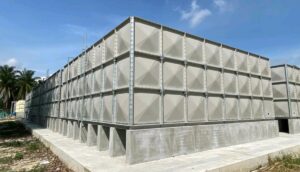
Modular water tanks, also known as sectional or panel tanks, are water storage systems created by assembling individual panels on-site. These panels, typically made from materials like glass-fused-to-steel, are manufactured with pre-punched bolt holes and are designed to fit together seamlessly. Using specialized gaskets and sealants, the panels are bolted together to form a leak-proof and durable structure.
A primary advantage of this design is its incredible flexibility and scalability. Because the tank is built from separate modules, its size and shape can be customized to fit specific site constraints. If your water storage needs grow over time, you can easily add more panels to increase the tank’s capacity. This adaptability makes modular tanks a highly practical and cost-effective solution for a wide range of applications, from agricultural water storage to industrial process water.
Modular tanks reduce shipping costs by up to 60%.
Want a container loading plan for your project? Contact our team now.
What Are Welded Water Tanks?
Welded water tanks are constructed by welding large steel plate sections together directly at the project site. This process creates a single, monolithic structure that is known for its strength and structural integrity. Once the welding is complete, the tank’s interior and exterior surfaces are coated to protect against corrosion. This on-site fabrication process requires skilled welders and specialized equipment, which can increase labor costs and project timelines.
While welded tanks are robust, they come with certain disadvantages. The quality of the corrosion resistance often depends on the conditions during on-site application, which can be inconsistent. Unlike modular tanks, welded tanks are permanent structures, meaning they cannot be easily expanded, downsized, or relocated if your operational needs change. Their large, bulky nature also makes them difficult and expensive to transport, particularly for export projects.
Why Modular Water Tanks Are Better for Export Projects
For export projects, modular water tanks offer clear advantages over their welded counterparts. The primary benefits stem from their design, which directly addresses the biggest challenges of international projects: shipping, installation, and long-term reliability.
The ability to pack panels flat makes shipping more affordable, while the simple bolt-together assembly reduces installation time and reliance on specialized local labor. Furthermore, their superior corrosion resistance and scalability make them a more flexible and durable long-term investment. Let’s look at these benefits more closely.
Lower Shipping Cost (Critical for ROI)
One of the most significant hurdles in any export project is managing logistics and shipping costs. This is where modular tanks have a distinct edge.
Because they consist of individual panels, modular tanks can be packed flat and stacked compactly into standard shipping containers. This efficient use of space dramatically reduces the shipping cost compared to transporting bulky, pre-fabricated sections of a welded tank.
For your project’s return on investment (ROI), these savings are critical. Lower transportation expenses mean more of your budget can be allocated to other important areas. The benefits include:
Maximized container space
Reduced freight charges
Easier handling and unloading at the destination port
Simplified transport to remote or hard-to-reach installation sites
Faster Installation (Save Time & Labor)
Time is money, especially on large-scale projects in another country. The ease of installation offered by modular tanks translates directly into savings on labor costs and shorter project timelines.
Unlike welded tanks that require extensive on-site welding, hot work permits, and specialized inspections, modular tanks are assembled using a straightforward bolting process. The pre-fabricated panels are simply lifted into place and bolted together.
This streamlined process significantly cuts down the installation time, often allowing a modular tank to be assembled up to three times faster than a welded one. The key advantages are:
No need for highly specialized welders on-site
Reduced on-site equipment requirements
Minimal weather-related delays
Quicker project completion and faster commissioning of the system
Superior Corrosion Resistance
When you’re investing in a tank for an overseas project, you need it to last. The longevity of a steel tank is largely determined by its corrosion resistance, and this is another area where modular tanks excel.
The coatings on modular tank panels, such as glass-fused-to-steel or fusion-bonded epoxy, are applied in a controlled factory environment. This ensures a uniform, high-quality finish that is free from the inconsistencies that can plague on-site coating applications for welded tanks.
This durable, factory-applied layer provides a powerful barrier against rust and degradation, ensuring a longer service life with less maintenance. The benefits of this superior protection include:
Consistent coating thickness and quality
Exceptional resistance to environmental factors and stored liquids
Reduced need for costly future repairs or recoating
Enhanced overall durability and longevity of your investment
Flexible & Scalable Design
Project requirements can evolve. A key benefit of modular tanks is their inherent flexibility and scalability, which future-proofs your investment.
Because the tank is constructed from individual panels, its design is not set in stone. This makes modular tanks an ideal choice for operations that anticipate future growth or changes.
If your water storage needs increase, the tank’s capacity can be expanded by simply adding more panels. Conversely, the tank can be downsized or even completely disassembled and relocated to a new site if necessary. This level of adaptability is impossible with a permanent welded structure. Key features include:
Easy expansion to accommodate growing needs
Ability to be disassembled and moved
Customizable shapes to fit unique site footprints
A cost-effective way to adapt to changing operational demands
Consistent Factory Quality
With any export project, you want to minimize the risk of defects or quality issues. Modular tanks provide peace of mind through their consistent, factory-controlled manufacturing process.
Every panel is produced to exact specifications under strict quality control protocols. This includes the application of coatings, the punching of bolt holes, and the overall finish of the modular panels. This factory quality ensures that every component arriving at your site is ready for assembly without unexpected issues.
In contrast, the quality of a welded tank is highly dependent on on-site conditions and the skill of the crew. With modular water tanks, you get predictable durability. This approach delivers:
Reliable, uniform panel and coating quality
Reduced risk of on-site fabrication errors
Simplified maintenance, as individual panels can be replaced if damaged
A dependable, long-lasting water storage solution
GRP vs FRP vs SMC — Which Modular Tank Is Best?
When selecting a modular tank, you’ll encounter various materials, often referred to by acronyms like GRP, FRP, and SMC. These terms all relate to fiberglass composite materials known for their durability and excellent corrosion resistance. GRP stands for Glass Reinforced Plastic, while FRP means Fiberglass Reinforced Polymer—these two are often used interchangeably. SMC, or Sheet Molding Compound, is a specific type of high-strength fiberglass composite.
While steel-based modular tanks (like glass-fused-to-steel) are extremely popular, fiberglass options offer their own set of advantages, particularly for certain applications. They are lightweight, completely rust-proof, and resistant to a wide range of chemicals. Key benefits of these fiberglass materials include:
Exceptional corrosion resistance
Lightweight for even easier transport and handling
High strength-to-weight ratio
Durability in harsh environmental conditions
Often used for potable water and chemical storage
Recommended for export:
GRP / SMC modular tanks (balance of cost + durability)
How to Choose the Right Tank for Your Project
Selecting the right tank type for your project requires careful consideration of several key factors. First, think about what you will be storing. The requirements for potable water are different from those for wastewater, fire protection water, or dry bulk storage. The liquid’s chemical composition will influence the best coating and material choice. Next, evaluate your project site. Is it in a remote area with limited access or a harsh climate? This will impact transportation logistics and the need for durability.
Also, consider your budget and timeline. Modular tanks often have a lower total cost of ownership due to reduced shipping and installation expenses. Finally, think about the future. Do you anticipate needing to expand your storage capacity or even relocate the tank? Your answers to these questions will help you determine whether a flexible modular tank or a permanent welded tank is the right fit.
Get a Custom Modular Water Tank Solution for Your Project
Every project has unique requirements, and your water storage solution should be tailored to meet them. With modular tanks, you get a custom solution designed for your specific needs. Whether you need a tank for potable water in a developing community or a large-scale industrial application, the design can be configured to the exact capacity and footprint you require. This level of customization ensures optimal performance and efficiency.
We specialize in export-ready modular water tanks, including:
GRP Water Tanks
FRP Water Tanks
SMC Panel Tanks
✔ Free design & layout drawings
✔ Container loading optimization
✔ Fast global delivery
✔ OEM / bulk order support
Frequently Asked Questions
Are modular water tanks easier to export than welded tanks?
Yes, absolutely. Modular tanks are much easier to export because their panels can be packed flat, which significantly lowers the shipping cost. Their straightforward, bolt-together design also simplifies the ease of installation in remote locations, making them ideal for export projects compared to bulky welded tanks.
How do modular and welded water tanks compare in cost for U.S. projects?
For U.S. projects, modular tanks often offer a better return on investment (ROI). While initial material costs can be competitive, the major savings come from reduced labor costs and faster installation time. Welded tanks require expensive, specialized labor for a longer duration, making modular tanks a more cost-effective choice overall.
Can modular water tanks handle harsh climates during overseas shipping?
Yes. Modern modular tanks are built for durability. Thanks to advancements in materials and factory-applied coatings that provide superior corrosion resistance, the panels are well-protected against moisture and temperature fluctuations during overseas shipping. This ensures the components arrive on-site in excellent condition, ready for assembly.