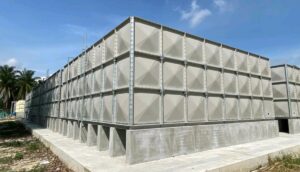
Choosing the Right Water Tank Material
Selecting the right water tank is critical for industrial, commercial, and municipal water storage. Tanks must withstand pressure, resist corrosion, maintain water quality, and meet operational needs. Common materials include HDG (Hot-Dip Galvanized) steel, GRP/FRP (Glass Reinforced Plastic), Stainless Steel, and modern SMC water tanks. Each offers unique advantages and limitations, affecting installation, longevity, maintenance, and cost.
This guide provides a detailed comparison to help engineers, facility managers, and buyers make informed decisions. It also highlights water treatment considerations for maintaining water quality in each type of tank.

HDG Water Tanks (Hot-Dip Galvanized Steel)
Choosing the right steel water tank requires balancing cost, durability, and corrosion resistance. Hot-Dip Galvanized (HDG) steel tanks are widely used in industrial, municipal, and commercial water storage because they combine structural strength with long-term performance. Below is a detailed look at their advantages, limitations, applications, and water treatment considerations.
Overview
Hot-Dip Galvanized steel tanks are manufactured by immersing structural steel panels into molten zinc, forming a protective layer that resists rust and corrosion. This process ensures both mechanical strength and cost-effective durability, making HDG tanks suitable for large-volume water storage or installations requiring high structural reliability.

Key Advantages
- Durability and Strength: Capable of handling significant water pressure, HDG tanks are ideal for multi-story buildings, elevated water towers, and municipal reservoirs. With proper maintenance, the zinc coating can help the tank last 15–20 years.
- Cost-Effectiveness: HDG tanks have a lower upfront cost compared to stainless steel, making them attractive for projects with budget constraints.
- Proven Technology: With decades of successful application worldwide, HDG tanks provide predictable performance and manageable maintenance schedules.
Limitations
- Maintenance Requirements: Zinc coating can be compromised by scratches or damage, requiring periodic inspection and minor touch-ups to prevent corrosion.
- Weight Considerations: Heavier than GRP or FRP tanks, HDG tanks may need reinforced foundations or supports, especially for elevated installations.
- Chemical Sensitivity: Not ideal for highly acidic, saline, or chemically aggressive water, which can accelerate corrosion.
Applications
- Municipal water storage and elevated tanks
- Industrial process water reservoirs
- Firefighting and emergency water storage systems
- Large-scale agricultural irrigation
Water Treatment Considerations
HDG tanks are compatible with most standard water treatment processes, including filtration, sedimentation, and chlorination. However, monitoring pH is essential to prevent zinc leaching, especially in soft or slightly acidic water. Neutralizing or pH-adjusting systems can further protect the tank and maintain water quality over time.
GRP / FRP Water Tanks (Glass Reinforced Plastic)
For applications requiring chemical resistance, lightweight design, and low maintenance, GRP (Glass Reinforced Plastic) or FRP tanks are an increasingly popular choice. These tanks are ideal for industrial, municipal, and food-grade water storage where durability must combine with corrosion resistance. SMC (Sheet Molding Compound) tanks are a specialized type of FRP, offering consistent quality and rapid installation.
Overview
GRP/FRP water tanks are constructed from polyester resin reinforced with glass fibers, forming a robust, corrosion-resistant structure. SMC tanks are pre-molded sheets of reinforced resin, designed for precision and faster deployment. Compared to metal tanks, these materials are significantly lighter, reducing transportation and installation challenges while maintaining structural integrity for medium to large volumes of water.

Key Advantages
- Corrosion and Chemical Resistance: GRP/FRP tanks resist acidic, alkaline, and saline water, making them ideal for treated water, chemical storage, and industrial processes.
- Lightweight and Modular: The panels or molded sheets are easy to transport and assemble, allowing modular designs for customized tank sizes.
- Low Maintenance: Unlike HDG tanks, GRP/FRP requires minimal upkeep and is not prone to rust or metal fatigue.
- Customizable for Applications: Available in various sizes, panel thicknesses, and configurations, including elevated, underground, and roof-mounted tanks.
Limitations
- Structural Strength: While strong, GRP/FRP tanks are not as mechanically robust as HDG or stainless steel. Large-volume tanks may require internal bracing or reinforced foundations.
- Cost Consideration: Higher upfront costs than HDG steel for equivalent volumes, though offset by lower maintenance over time.
- UV Sensitivity: Long-term sun exposure may degrade resin unless UV inhibitors are incorporated.
Applications
- Municipal water storage and elevated tanks
- Industrial process water reservoirs
- Firefighting and emergency water storage systems
- Large-scale agricultural irrigation
Water Treatment Considerations
GRP and SMC tanks are fully compatible with modern water treatment solutions, including filtration, chlorination, reverse osmosis, and UV sterilization. Their non-metallic structure prevents contamination or scaling, making them ideal for potable water and chemically treated industrial water.
Stainless Steel Water Tanks
For applications demanding ultimate corrosion resistance, hygiene, and durability, stainless steel water tanks are the industry standard. They are widely used in drinking water, food and beverage, pharmaceutical, and high-purity industrial water storage. With smooth, non-porous surfaces and superior material strength, stainless steel tanks ensure both water quality and long-term reliability.
Overview
Stainless steel tanks are commonly made from SS304 or SS316, offering exceptional resistance to rust, acidic water, and high-salinity environments. Unlike steel or GRP tanks, stainless steel does not leach metals into stored water, making it ideal for potable and sensitive industrial water. These tanks can be custom-fabricated in various shapes and sizes, including cylindrical, rectangular, and modular configurations, and are suitable for both aboveground and elevated installations.

Key Advantages
- Superior Corrosion Resistance: Stainless steel resists chemical attack, rust, and staining, even under extreme environmental conditions.
- Hygienic and Easy to Clean: Smooth interior surfaces prevent bacterial growth and biofilm accumulation, making them suitable for potable water and food-grade applications.
- Durability and Lifespan: With minimal maintenance, stainless steel tanks can last 25–30+ years, outperforming both HDG and GRP options.
- Temperature and Pressure Resistance: Can handle hot water storage and variable pressures without compromising structural integrity.
Limitations
- High Initial Cost: Stainless steel tanks are more expensive upfront than HDG or GRP tanks, though their long lifespan often justifies the investment.
- Weight Considerations: Heavier than FRP/SMC, requiring proper foundation support, but usually lighter than HDG for equivalent volumes.
- Fabrication Complexity: Custom shapes or large-volume tanks require skilled welding and precise fabrication, potentially increasing lead time.
Applications
- Municipal and commercial drinking water storage
- Food and beverage processing
- Pharmaceutical and laboratory water storage
- Industrial high-purity water applications
Water Treatment Considerations
Stainless steel tanks are compatible with all modern water treatment systems, including filtration, chlorination, reverse osmosis, and UV sterilization. Their non-reactive surfaces prevent contamination or scaling, making them ideal for potable water and chemically treated industrial water. For high-purity applications, seamless welded designs further reduce biofilm risks and simplify maintenance.
Water Tank Material Comparison
Selecting the right water tank material depends on factors such as corrosion resistance, durability, weight, cost, and compatibility with water treatment systems. The following table provides a clear comparison of HDG, GRP/FRP, and Stainless Steel tanks, helping engineers and facility managers make informed decisions.
| Feature / Material | HDG Steel | GRP / FRP | Stainless Steel |
|---|---|---|---|
| Construction | Steel panels with zinc coating | Polyester resin reinforced with glass fibers | SS304 or SS316 stainless steel |
| Corrosion Resistance | Medium – susceptible to scratches and chemical attack | High – resistant to acids, alkalis, salts | Very High – exceptional corrosion resistance |
| Weight | Heavy | Lightweight | Medium |
| Durability (Years) | 15–20 | 20–25 | 25–30+ |
| Maintenance | Moderate – requires periodic inspection and touch-ups | Low – minimal maintenance | Minimal – cleaning and occasional inspection |
| Cost | Low | Medium | High |
| Water Quality Impact | Possible zinc leaching in soft/acidic water | Neutral | Neutral – non-reactive |
| Installation | Requires reinforced support for heavy loads | Modular and flexible | Requires structural support for large volumes |
| UV Resistance | High | Needs UV inhibitors for outdoor exposure | High |
| Typical Applications | Municipal water storage, industrial water, firefighting | Industrial, chemical, municipal treated water | Drinking water, food & beverage, pharmaceutical, high-purity industrial water |
| Water Treatment Compatibility | Compatible with filtration and chlorination, monitor pH | Fully compatible, ideal for RO, UV, chlorination | Fully compatible, non-reactive, ideal for all modern water treatment |
Water Treatment Solutions & Integration with Tanks
Proper water storage is only one part of an effective water management system. To ensure water quality, longevity of tanks, and regulatory compliance, it is essential to integrate the right tank material with appropriate water treatment solutions. Different materials interact differently with treatment processes, so choosing the right combination is key for industrial, municipal, and commercial applications.
Filtration and Sedimentation
All tank types—HDG, GRP/FRP, and stainless steel—are compatible with standard filtration and sedimentation systems. GRP and stainless steel tanks are particularly advantageous for high-purity or potable water, as their smooth, non-porous surfaces prevent biofilm and reduce sediment accumulation. HDG tanks perform well in municipal or industrial applications but require monitoring for corrosion where sediment may interact with zinc surfaces.
Reverse Osmosis (RO) Systems
For treated water applications using RO systems, non-metallic tanks such as GRP/FRP and SMC are preferred for pre-treated water storage. These materials prevent scaling and contamination, ensuring the RO system operates efficiently. Stainless steel tanks are also highly compatible and are recommended for high-purity RO storage, particularly in food, pharmaceutical, or laboratory contexts. HDG tanks can be used with RO water but may require additional pH control to avoid zinc leaching.

Chemical Dosing and Softening
Industrial and municipal water treatment often involves chemical dosing—such as chlorine, anti-scalants, or softening agents. GRP/FRP and SMC tanks resist chemical attack, making them ideal for storage in these conditions. Stainless steel tanks also handle chemical-treated water without risk of contamination. HDG tanks may face corrosion challenges if exposed to aggressive chemicals, so compatibility should be assessed before installation.
UV Sterilization and Disinfection
UV systems are commonly used to disinfect potable water. Stainless steel and GRP/FRP tanks are fully compatible with UV-treated water, as both materials do not react with UV exposure or compromise water quality. HDG tanks can also be used, but prolonged exposure of water to UV-treated surfaces with zinc may require monitoring to ensure no metal leaching occurs.
Ready to Choose the Right Water Tank for Your Needs?
At TIY, we understand that selecting the right water tank is critical for durability, water quality, and long-term operational efficiency. Whether you require HDG steel for large municipal projects, GRP/FRP or SMC tanks for chemical-resistant or low-maintenance applications, or stainless steel for potable and high-purity water, TIY offers tailored solutions to meet your requirements.
Conclusion
Choosing the right water tank material is key to ensuring durability, water quality, and operational efficiency. At TIY, we offer a full range of solutions—HDG steel tanks for cost-effective industrial and municipal storage, GRP/FRP and SMC tanks for lightweight, corrosion-resistant, and low-maintenance applications, and stainless steel tanks for hygienic, high-purity, and long-lasting water storage. By selecting the appropriate material and integrating it with modern water treatment systems, TIY helps you achieve reliable, efficient, and tailored water storage solutions for industrial, commercial, and municipal needs.
Frequently Asked Questions
1. What is the difference between HDG, GRP/FRP, and stainless steel water tanks?
HDG tanks are steel with a zinc coating, offering cost-effective durability but requiring maintenance. GRP/FRP tanks are lightweight, corrosion-resistant, and low-maintenance, with SMC tanks being pre-molded for high consistency and rapid installation. Stainless steel tanks provide superior corrosion resistance, hygiene, and long-term durability, ideal for potable or high-purity water.
2. Can TIY water tanks be used with treated or chemical water?
Yes. GRP/FRP, SMC, and stainless steel tanks are fully compatible with treated water, RO systems, chlorination, and UV sterilization. HDG tanks can handle treated water but require monitoring of pH levels to prevent zinc leaching in soft or acidic water.
3. How long do different water tank materials last?
HDG steel tanks typically last 15–20 years with proper maintenance. GRP/FRP and SMC tanks last 20–25 years, while stainless steel tanks can exceed 25–30 years, depending on usage and environmental conditions.
4. Are FRP and SMC tanks suitable for food-grade or potable water?
Yes. SMC tanks, in particular, are ideal for food-grade water due to their pre-molded, consistent quality. Both FRP and SMC tanks prevent contamination and are compatible with modern water treatment systems.
5. Which TIY water tank is best for large industrial or municipal projects?
HDG steel tanks are often preferred for large-volume industrial and municipal storage due to their structural strength and cost-effectiveness. GRP/FRP tanks are also suitable if chemical resistance, lightweight design, or low maintenance is required. Stainless steel is recommended for high-purity water or food-grade applications.